
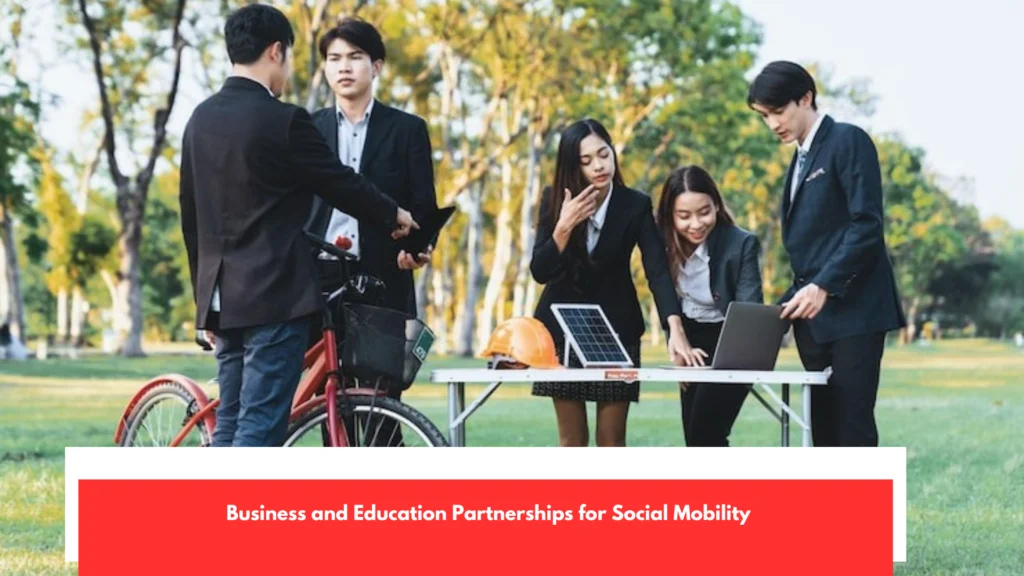
Business and Education Partnerships for Social Mobility. Imagine a first-generation college student passing through the graduate phase, with the tuition fees paid using a business scholarship which realized her potential. Imagine a young man in a disadvantaged neighborhood, who now working as an expert technician at the nearby manufacturing plant, after trained by a company-sponsored apprenticeship program. Consider a low-wage earning single mother who went on to become a cybersecurity professional after completing a business-sponsored training plan at her community college.
Such stories are the epitome of American business and educational institutions working together, which is creating the important pathways to economic mobility. This partnership is changing the story of opportunities among people of various backgrounds and it shows that when corporations and academicians join they can open doors of opportunities to those who are most in need. The Changing face of Corporate Responsibility. In the recent past, the customary approach in business involvement in education meant giving a donation to a nearby school and a press release.
The Changing Face of Corporate Responsibility

Business and Education Partnerships for Social Mobility. Modern, forward-thinking businesses realize that their participation in education is becoming more crucial and important. Instead, they are not only players but active partners in designing learning experiences that enable learners to be successful in the world. This development represents a growing recognition of the fact that businesses do care about the outputs of education. Businesses can not thrive in environments where potential workers not equipped with the necessary skills, where societies have to battle poverty and inequality, or when major segments of the population excluded.
In economic prospects. Companies are not only doing a favor to the community but investing in education are creating an environment in which they can continue to thrive when they invest. Outside of Financial Support: The Multiple Types of Support. Despite the need of financial support, the most effective business-education partnerships involve much more than funding: Transformative Mentorship To many youths, especially those with marginalized backgrounds, financial support is not the most precious thing, but a network to a mentor who can shed some light on possible opportunities.
More Than Money: The Many Forms of Support

Companies like IBM and Salesforce have put up holistic mentorship programs that pair professionals with students, providing them with career advice, as well as necessary support and role modeling. Association with professional pathways Curriculum. Companies are also helping teachers relate classroom learning to work needs. It is through the collaboration of technology companies with institutions of computer science that the relevant programming languages are acquired by the students. Healthcare professionals can help in the creation of nursing programs based on the current medical technologies.
Business and Education Partnerships for Social Mobility. Such relationships ensure that education is not only a transmission of knowledge but also the development of practical skills. Occupational Experiences That promote Confidence. Besides instilling a certain set of skills, internships and apprenticeship programs also help students develop professional identities and networks. A student who does an internship in an engineering firm does not merely learn engineering, but he or she starts to consider himself or herself an engineer.
Mentorship That Changes Trajectories

Business and Education Partnerships for Social Mobility. This change in self concept is potentially revolutionary especially among students who might not otherwise dream of holding professional roles. The Consequential Investment of Education. The benefits of investing in education are greater than the immediate help that the students have received. Fortifying Local Economies Regions with good educational facilities attract and retain businesses creating positive investment and opportunity cycles. Companies which support local education are not only producing future workers, they are also creating communities where people want to live and work professionally.
Busting Intergenerational Patterns. It is a well-known fact that education is considered the most reliable way to get out of poverty. When businesses become more available and responsive in education, they are not only changing the lives of individual people, they are also helping to break the cycle of generations. Encouraging Innovation and Mobility. A skilled workforce involves more than just the possession of people possessing specific technical skills. It relates to the development of citizens who would think critically, solve complex problems and respond to changing situations flexibly.
Conclusion

These qualities improve the resilience of communities and boost the economic energy. Difficulties Addressing. Despite the clearly visible benefits, these partnerships face significant challenges that require a keen management. Ensuring Fair Indemnities. The worry is that corporate funding can be highly skewed in favor of already wealthy colleges or courses of study that serve students with innate advantages. Even the most successful partnerships work hard to ensure that the students who face great challenges, whether economic, geographic, or social are reached.
Align Urgent Requirements and Strategy Objectives. Nature of businesses is to focus on the development of the exact skills that are needed at the moment; however, education has to help students be ready to the unpredictable and rapidly changing world too. The best working arrangements respect the overall goals of education and, at the same time, meet the attainable workplace needs. promoting Academic integrity. Concerns about commercial interests in educational contents or priorities are valid. Powerful partnerships outline clear boundaries that respect the principles of education, and combine.