
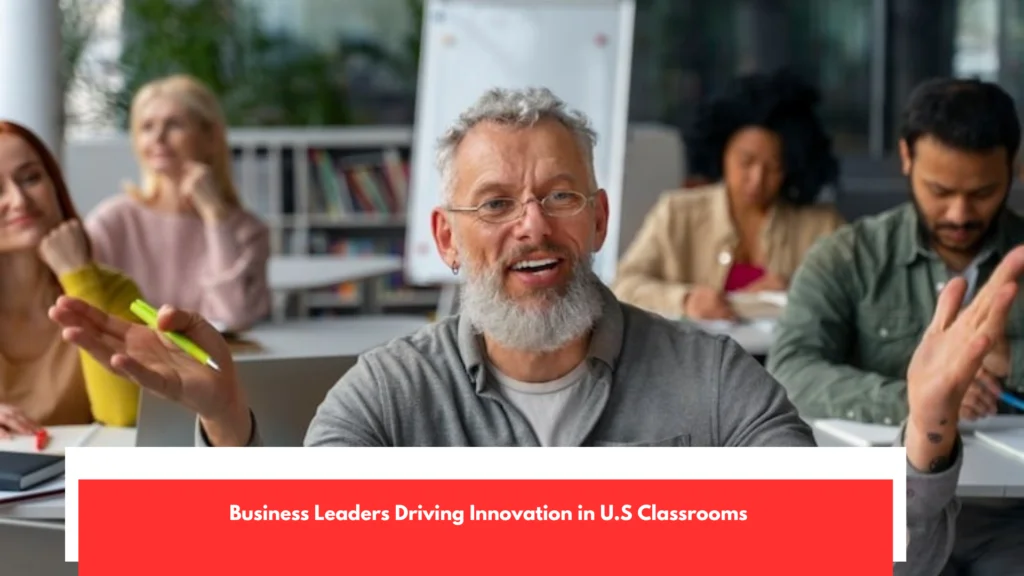
Business Leaders Driving Innovation in U.S Classrooms. Imagine a high school student out in the Appalachian countryside coming up with clean energy solutions using the same simulation software that a professional engineer uses. Imagine a middle school classroom in which artificial intelligence applications can help teachers determine which mathematical concepts a particular student needs to practice. These events do not refer to the far future they taking place in American classrooms today, which can explained by an important shift in the relationship between corporations and teachers.
In particular, the relationship between corporations and schools has evolved from occasional donations to deep, intentional partnerships. As a result, these collaborations are now transforming the way students learn and prepare for the future. Businesses actively finding their way into the classrooms to ensure that learners well equipped to contribute to workforce once they join the labour market. The Importance of such a Partnership now. We live in a very spectacular age of technology change. The skills that were important ten years ago are changing, and new ones continue to emerge constantly.
Navigating the Challenges Together

Business Leaders Driving Innovation in U.S Classrooms. Traditional educational systems, which have often restricted by bureaucracies and budgetary constraints, have struggled to focus on these rapid changes. At the same time, business executives confronted with a confusing paradox: massive amounts of college graduates are flooding the labor market but millions of jobs go unfilled because businesses can hardly find people with the necessary skills. This lack of connection has created a strong motivation to active involvement of enterprises in the education process.
The forward-looking businesses appreciate that sponsoring institutions of learning not only beneficial in the field of recruitment but also indispensable in the development of a strong and creative society that needed to achieve sustainable corporate success. The way Enterprises Are affecting Natural Classrooms. The most stimulating aspect of this collaboration its newly acquired reality. Firms are no longer writing checks they are offering their most valuable resources namely experience, technology and practical knowledge. Combining Future Technologies with Modern Classrooms.
Looking Toward the Future Together

Business Leaders Driving Innovation in U.S Classrooms. Many companies are making substantial investment in instructional technology; however, there are far more contributions than simply delivering gadgets. Some of these corporations like Google and Microsoft have developed holistic ecosystems of educational products which can help educators to personalize instruction. Google Classroom platform is not just a convenient tool but a channel through which students can be developed on digital collaboration skills which are vital in the modern workforce.
Their creative products, because they realize that cultivating creativity in young people has a long-term benefit to the society at large. Teaching a curriculum together, in a way that works to equip students. The most striking change has been in the way of how businesses shape the learning curricula. Instead of decrying the lack of particular skills among graduates, employers are cooperating with teachers to design the content of the curriculum that meets the real needs of employment. To offer the desired programming languages, technology companies have partnered with schools to come up with coding bootcamps.
A Partnership for Everyone’s Benefit

Healthcare organizations have been active in the formation of the nursing programs that bring into action the latest medical simulation technologies. Even industries like hi-tech manufacturing are also taking part by providing equipment and skills to tertiary schools to prepare them to earn high-paying technical skills. These partnerships will ensure that students do not only get theoretical knowledge but also practical skills that will make them a worthwhile employee at the very beginning. Providing Opportunities through Mentorship and Experience. The opportunity to interact with professionals and gain.
Real-life experience in the workplace can be the most transforming factor in business-education relationship to many students. Companies across the country are increasing internship programs, career fairs and assigning employee mentors to children. Such experiences do not only make resumes shine but also help students to understand how the theoretical knowledge they have acquired in academics relates with what they have done in the real world. A student who struggles with algebra can have a new interest when an engineer shows how those equations are used in the creation of safer bridges.
Building Confidence and Community through Strategic

A student who hopes to become a marketer can increase his or her confidence by shadowing a brand manager a day. Investing in the Community through Strategic Philanthropy. Many companies are investing in their most-needed areas in the form of corporate social responsibility. Businesses are covering scholarships of disadvantaged students, supporting training of teachers in low-income schools and helping to build modern laboratories of STEM in those communities that are not financial. These investments do recognize the fact that talent is evenly spread over the society but opportunity is not.
By enabling a fair playing field, companies are not only being altruistic, but they are also hedging against missing the chance of having brilliant talent to go to waste. Working together to solve the problems. There have been no issues that have been left unrelated to this emerging alliance. Some teachers are worried about the overt power of corporations that control the material taught in school, particularly where the commercial goals of the corporation can be at odds with the education. The legitimate issues with privacy exist when technological businesses provide free solutions that collect student data.