
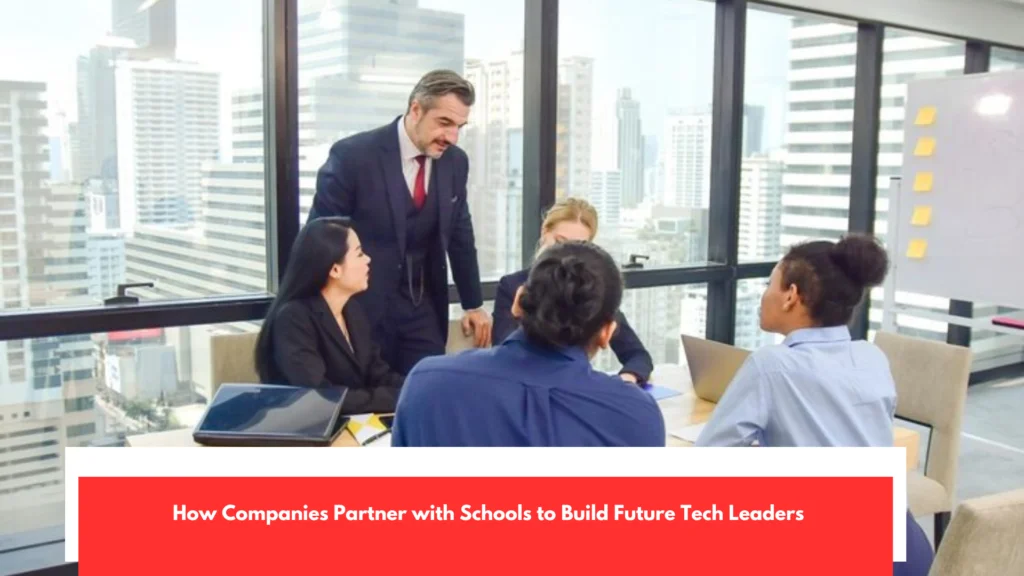
These are not images of a far and idealized future. They are the pieces of a great, modern-day reality that is cropping up all over in the United States: a necessary and deep-seated relationship between the overworld of business and the overworld of education. The old model of education, wherein students learn and study in a vacuum over the course of two decades and then become members of the employees, is an absolute failure in the rapidly changing digital economy today.
Technology is not evolving on an annual basis, but every month. The working relationship between the U.S. corporate and the educational sectors has not only developed to be more of a philanthropic project but has come to be an essential plan of national competitiveness, innovation and personal success. This group is working hard to build a bridge between the classroom and the boardroom with the hope of ensuring that the coming generation is not just ready to take over, but is also in a position to shape the future. The Necessity to Press: Educational Meets Employment.
Investment in Technology and Resources

The technology industry in the U.S. is an endless source of growth, and it generates insatiable needs in skilled people in the field of artificial intelligence, cybersecurity, data science, and software development. However, there is always an ongoing and frustrating gap. Employers find it difficult to find talent enough to fill the available positions, graduates often feel that their training does not equip them to handle practical, special issues of the modern workplace. It is that gap which is the object of business-education partnerships. Business organizations have become more than consumers of talent, but rather, co-creators.
Through learning, they ensure that learners are acquiring a collection of skills that are not only theoretically sound, but also immediately practical. It is not a replacement of the vital process of critical analysis and creativity taught in academic institutions; it is a supplement of such with hands on, applied knowledge that will make a graduate an innovator in the first place. The Playbook: How Corporates are becoming more and more active.
The Benefits for Both Education and Business

This collaboration takes a number of different forms and each attempts to solve a different part of the puzzle. Joint Curriculum Design Instead of complaining that freshly graduated individuals are not job ready, major technology companies are collaborating with the school districts to co-design lesson units. They provide advisory boards which provide real time information on the coding languages, development frameworks and security procedures that are currently being implemented in the business. This makes the curriculum an active text that continuously.
Changes with the changing technology. The Importance of Experience: Internships and Apprenticeships: No substitutes. Business firms are also creating full-fledged internship and apprenticeship schemes which transform schools into students and active learners. A student can also spend a semester troublehooting a new program, or looking at real user data. Such experiences cannot be done without, often leading to full-time employment opportunities and supporting.
Building the Future Together

An essential education-to-career pipeline. Empowering Future Generations A lot of educational institutions, particularly in lack of privilege areas, lack access to sophisticated technologies. Corporations are making equity through donation of hardware, software and cloud computing credits. Imagine a student learning about data science not by reading some examples in a textbook, but using a powerful cloud platform deployed in leading organizations.
This explains technology and creates confidence. The Human Connection: Mentorship Other than equipment and money, the time can create the biggest gift. Technology experts are taking on the role of mentors, helping students with more complex projects, giving them advice on their careers, and showing them the possible results a course in STEM can bring. Such human interaction bridges the gap between theory and practice, explaining to students who they can be.
Conclusion

Getting Opportunities: Scholarships and Sponsorships: In order to ensure that technology is diverse and inclusive in the future, companies are funding scholarships to gifted students who have less-represented backgrounds. This would remove economic barriers and would mean that the industry is committed to developing a talent pool that is representative of the rich composition of America. Applied Implications: Partnering Projects. This is not abstract. It is occurring presently. At Code Next, Google offers free computer science labs and mentorship to underserved communities.
Which creates a new group of coders and creators who might not have otherwise had these opportunities. The TEALS Program of Microsoft represents an example of excellent volunteerism. The Microsoft employees also teach the computer science classes in the high schools in the countries, help the schools create the program to be self-sufficient and provide the educators with the power. The P-TECH School Model created by IBM is a new six-year program combining high school. Community college and paid work experience. The students receive an associate degree and a direct path to a job.